
Small software has a useful constraint: it cannot win by containing everything. It has to decide which problem deserves a dedicated place on a device, then solve that problem with enough care to justify the space it occupies.
That constraint is not a lack of ambition. Focus can demand more judgment than expansion. Every additional setting, service, screen, and business rule has a cost. The product becomes stronger when each cost is paid for a reason the person using it can feel.
Begin with one clear promise
Projects promises a calm path from idea to done. Wayfuel promises a useful estimate of what a road trip will cost in fuel. Those statements are narrow enough to guide decisions and broad enough to support meaningful depth.
A clear promise acts as a filter. Projects can add comments, timelines, nested boards, and real-time collaboration because each feature helps work move or makes that movement easier to understand. Wayfuel can combine routing, regional gas prices, vehicle data, terrain, and temperature because each input improves the estimate.
The same filter rejects plausible ideas. A feature can be technically impressive and still dilute the product. The question is not whether it can be built. The question is whether its absence would make the central promise meaningfully harder to keep.
Focus is not fewer features at any cost. It is a stronger relationship between every feature and the job of the product.
Respect the device
Software feels considered when it understands the environment around it. On the Mac, that means keyboard fluency, direct manipulation, familiar sheets, file-based resilience, and controls that do not fight the platform. On the iPhone, it means touch targets, fast inputs, clear hierarchy, responsive state changes, and a result that can be understood in a glance.
Native does not require visual imitation. It requires behavioral respect. A button should feel like a button. A sheet should appear with a clear purpose and disappear cleanly. Navigation should preserve context. The system should remain responsive when a network service takes too long.
A practical test
When a feature is removed from its marketing description, does the interface still reveal why it exists? The best product decisions are often legible without explanation.
Match the business model to the value
Pricing should describe the product honestly. Wayfuel offers two calculations before a $2.99 one-time Pro purchase. The core value is a focused utility on one device, so a recurring subscription would add pressure without adding recurring collaboration or service value.
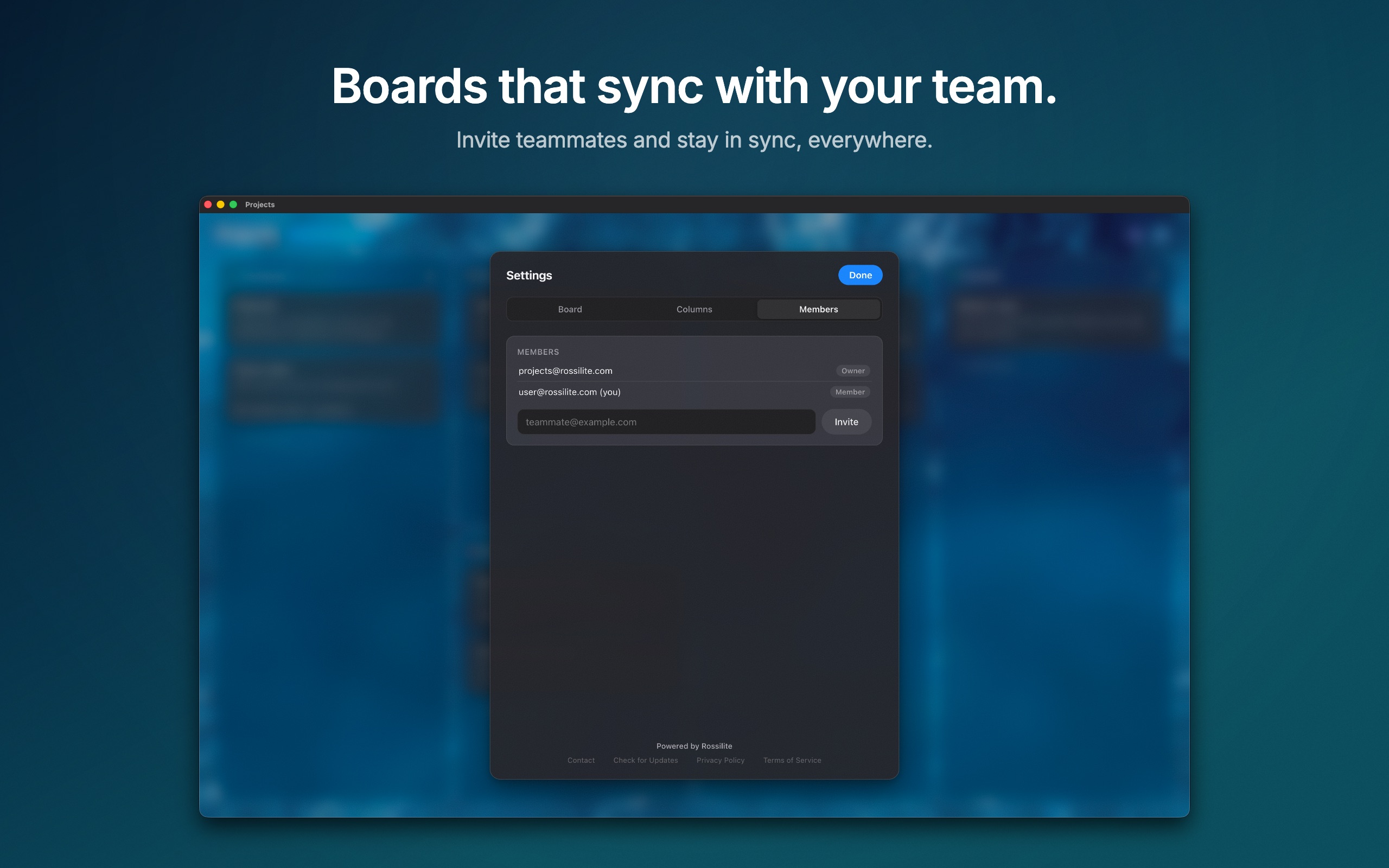
Projects takes a layered approach. Personal and additional local boards work without a subscription. Cloud Sync is optional and recurring because it adds shared boards, members, invitations, real-time updates, and infrastructure that continues to operate over time.
Neither model is a universal rule. A one-time price is not automatically more virtuous, and a subscription is not automatically more sustainable. The useful standard is alignment: does the way a product charges match the way it continues to create and carry value?
Privacy begins in the architecture
A privacy statement matters, but the strongest privacy choices happen earlier. Projects can keep local boards on the device because not every board needs a server. Wayfuel does not require an account, does not include ads or analytics, and keeps recents and favorites locally.
Some product functions necessarily contact services. Wayfuel sends requests to the mapping and data services needed to calculate a route and refine an estimate. Projects sends cloud-board data when Cloud Sync is chosen. Clear boundaries make those network interactions easier to explain because they follow the visible feature boundary.
This is another benefit of focus. A product with a smaller purpose can often collect less, retain less, and explain more. Restraint in data architecture supports restraint in the interface.
Know when the product is finished enough
Software is never permanently complete, but a release still needs a coherent stopping point. The central path should work. Failure states should be understandable. The visual system should remain calm under real data. The product should not rely on a future roadmap to justify what it asks of someone today.
After that point, the work changes. Additions need to earn their place against a product that already has a shape. Removing friction can be more valuable than adding surface area. A quiet fix to persistence, timing, or layout may do more for trust than a new headline feature.
Small software gets to be personal in the best sense. It can have a point of view. It can decline to become a platform. It can make a narrow promise, charge in a way that matches that promise, and spend its complexity where the person using it receives the benefit.